 Book now
Gödöllő: Hungary's Great Baroque Palace
How the Grassalkovich family built the largest Baroque palace in Hungary, and how it survived war and neglect to become the museum you visit today.
Before it was Sisi's, Gödöllő was the Grassalkovichs'. This is the story of the family who built Hungary's largest Baroque palace, the architecture they created, and how the building endured to our own day.
The Grassalkovich family
The palace owes its existence to one of the great success stories of eighteenth-century Hungary: the rise of the Grassalkovich family. Count Antal Grassalkovich I, born in 1694, came from relatively modest gentry origins and climbed through talent, loyalty and legal skill to the very top of Habsburg Hungary, becoming a trusted administrator and a confidant of Empress Maria Theresa. With high office came enormous wealth and vast estates, and like every great magnate of the age he wanted a seat that would proclaim his standing. Gödöllő, in gently wooded country a convenient distance from both Buda and Vienna, was where he chose to build it. Over the following decades the family poured its fortune into the estate, and across three generations the Grassalkovichs transformed a country residence into the most ambitious aristocratic palace in the kingdom. The dynasty did not last long at the summit — the male line died out in 1841, only about a century after the palace was begun — but in that time they created something that outlived them completely. To walk through Gödöllő is to see the taste, ambition and confidence of Hungary's Baroque aristocracy made permanent in stone, and to understand why, when a royal residence was later sought, this was the palace the nation reached for.
Building the palace: Mayerhoffer and the Baroque
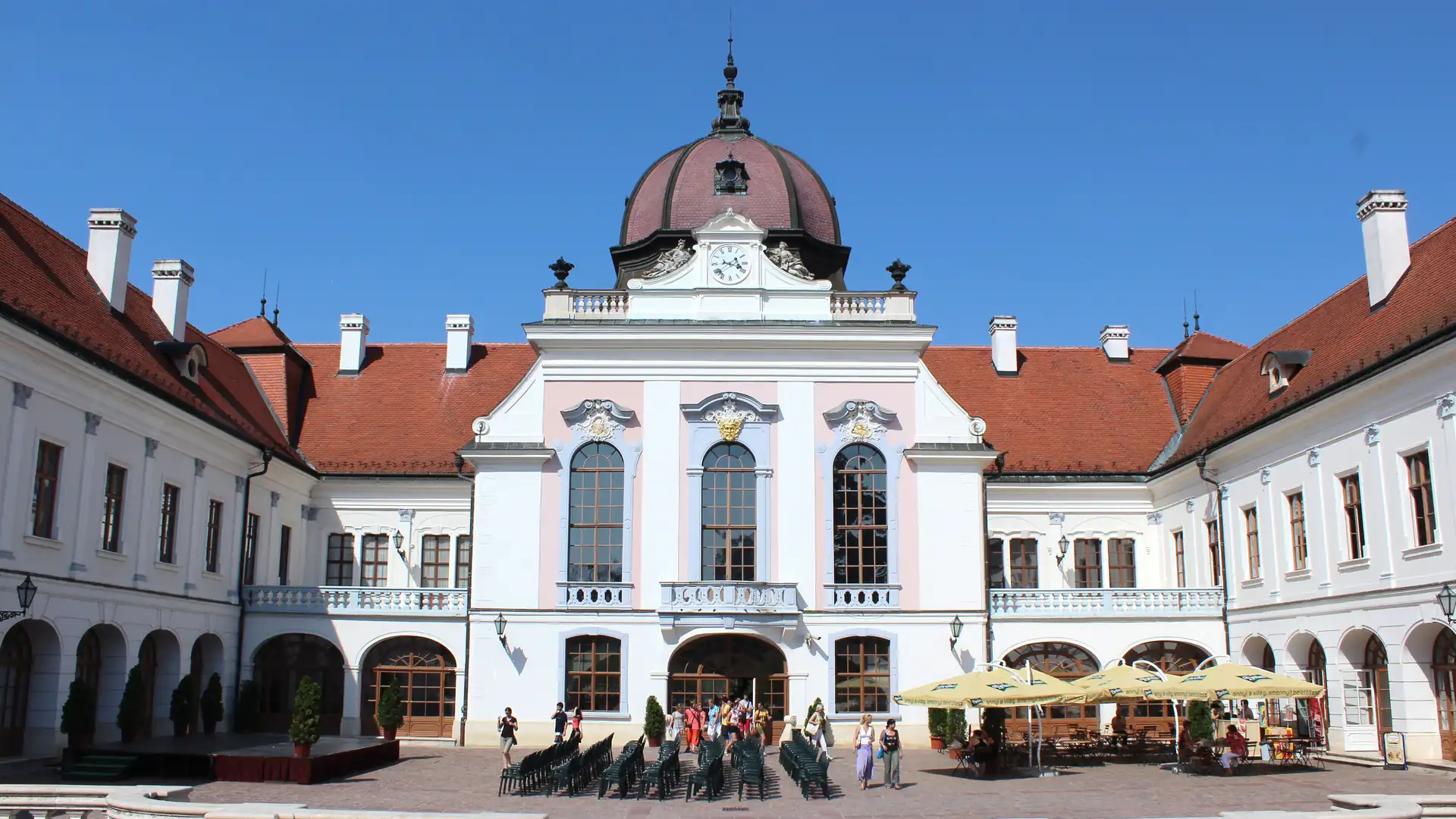
Construction of the palace began around 1735, to designs by András Mayerhoffer, an architect trained in Salzburg who became one of the leading builders of the Hungarian Baroque. What he laid out at Gödöllő set the template for the aristocratic country palace in Hungary for generations. The core of his design was a grand main block from which wings swept forward to embrace a ceremonial forecourt, an arrangement later extended into the distinctive double-horseshoe, or double-U, plan that gives the palace its enormous, welcoming spread when seen from the approach. The style is full-blooded Central European Baroque, warmed later by the lighter, more restrained Zopf manner of the late eighteenth century: symmetrical wings, a rhythm of tall windows, ornamented central pavilions and the characteristic warm ochre-yellow render that has become the palace's signature colour. Successive generations of Grassalkovichs enlarged and enriched what Mayerhoffer began, adding rooms, refining interiors and extending the wings until the palace reached the scale that makes it, still today, the largest Baroque palace in Hungary. It is worth pausing on the approach to take in the whole composition before you go inside: the long arms of the building reaching out around the court are the clearest statement of what Baroque architecture was for — to impress, to welcome and to display the power and cultivation of the family within.
A palace like a small town
Gödöllő was never a single building but a self-contained world, designed so that the family and its court need never leave. At its height the complex embraced eight wings and, around and among them, everything a great household required: its own church for worship, a riding hall for the horses that were central to aristocratic life, hothouses and a greenhouse for flowers, an orangery for tender plants, and — most remarkably of all — its own theatre for entertainment. This was a palace that could function almost as a small town, producing its own pleasures and provisions, hosting its own ceremonies, and moving between the sacred, the domestic and the festive without ever passing beyond its own walls. That completeness is part of what makes a visit so rewarding, because the palace offers not just grand rooms but a whole way of life to reconstruct in the imagination. The eighteenth-century Baroque Theatre, one of very few of its kind to survive anywhere in Europe, is the most extraordinary survivor of this self-sufficient world and can be seen today on a special guided tour. The riding hall, the glasshouses and the church all speak of the same ambition: to gather every necessity and every luxury of noble life into one designed and ordered estate. Understanding Gödöllő as a complete court in miniature, rather than as a single mansion, is the key to appreciating just how grand the Grassalkovich vision really was.
From private palace to royal residence
When the Grassalkovich male line died out in 1841, the palace passed out of the family that had created it and entered an uncertain period, changing hands and, for a time, being leased. Its second great chapter opened with the transformation of Habsburg Hungary itself. After the Austro-Hungarian Compromise of 1867 restored Hungary's constitutional standing, the nation looked for a fitting residence for its newly crowned king and queen, and Gödöllő — grand, self-contained and set in superb riding country near the capital — was the natural choice. Designated a royal residence, it was presented to Franz Joseph and Elisabeth, and for the next half-century, until the fall of the monarchy in 1918, it served as the Hungarian home of the sovereigns. This is the era to which the palace's interiors are now restored: the rooms you walk through are dressed as they were in the 1880s, at the height of the royal period, rather than as the Grassalkovichs would have known them a century earlier. The shift from private aristocratic palace to royal residence is central to Gödöllő's identity, because it layers two great stories onto the same walls — the ambition of the Baroque magnates who built it, and the affection of the empress who made it famous. Both are present as you move through the exhibition, and the best visits hold the two in mind at once.
War, neglect and rescue
The twentieth century treated Gödöllő harshly, and the fact that you can visit it in its restored glory today is the result of a long and determined rescue. Between the two world wars the palace served as a residence for Regent Miklós Horthy, and it was in this period that the fortified bunker beneath it was built. The Second World War and its aftermath were far more damaging. After 1945 the palace was occupied in turn by Soviet and Hungarian troops, and in the decades that followed the building was put to uses that came close to destroying it: parts were turned into a home for the elderly, the once-great park was subdivided, and the fabric of the palace was allowed to decay, its theatre walled up and forgotten. For a long time Gödöllő seemed a lost cause. The turnaround began in the closing years of the communist era. Formal monument protection was established in the early 1980s, and a major campaign of restoration got under way from the mid-1980s and continued through the change of political system, gradually reclaiming the palace room by room and reopening it to the public. In 1998 the surrounding English landscape park was declared a nature reserve, protecting the setting as well as the building. The restoration is an ongoing labour, and each phase returns more of the palace to life. Knowing this history adds depth to a visit: the rooms are beautiful in themselves, but they are also a hard-won recovery, saved from ruin within living memory.
Gödöllő and the golden age of the Hungarian Baroque
To stand in front of Gödöllő is to see the high-water mark of a whole architectural age. The eighteenth century was the golden era of the Hungarian Baroque, a period when the kingdom, recovering from long wars and Ottoman occupation, rebuilt itself in stone and stucco. Great aristocratic families competed to raise country palaces that would announce their wealth and loyalty to the Habsburg crown, and churches, town halls and monasteries rose across the land in the exuberant, curving Baroque manner imported from Austria and Italy and adapted to Hungarian taste.
Gödöllő is the grandest secular expression of that movement, and its architect, András Mayerhoffer, was among the style's leading practitioners, his work here setting a pattern that other noble houses would echo. The palace's warm ochre render, its symmetrical forward-sweeping wings, its ornamented central pavilions and the sheer generosity of its scale are all hallmarks of the age, softened in its later phases by the more restrained, classicising Zopf style that came into fashion toward the end of the century.
What distinguishes Gödöllő from its many cousins is not any single feature but its completeness and its size: where most Baroque mansions are a single grand block, Gödöllő grew into a vast, self-contained estate on a scale no other Hungarian palace matched. Seeing it in this light adds to a visit, because the building is not an isolated curiosity but the finest survivor of a confident, prolific era of Hungarian building — one whose churches and palaces you will spot again and again as you travel the country. It also explains why the nation later reached for Gödöllő when it wanted a residence worthy of a king and queen: no other private house in Hungary could match it for grandeur. The palace is, in effect, the Hungarian Baroque's masterpiece in the domestic key, and appreciating the tradition behind it deepens everything you see once you step inside.
Frequently asked
Who built the Royal Palace of Gödöllő?
It was built for Count Antal Grassalkovich I, a wealthy confidant of Empress Maria Theresa, beginning around 1735 to designs by the Salzburg-trained architect András Mayerhoffer. Three generations of the Grassalkovich family enlarged it into the largest Baroque palace in Hungary before the line died out in 1841.
What makes Gödöllő architecturally important?
It is Hungary's largest Baroque palace, laid out on a grand double-horseshoe plan with wings embracing a ceremonial forecourt, in warm ochre render. Beyond the main block it once held its own church, theatre, riding hall, orangery and glasshouses — a complete aristocratic court in miniature.
How did the palace become a royal residence?
After the Grassalkovich line ended in 1841 the palace changed hands, and following the Austro-Hungarian Compromise of 1867 it was designated a royal residence and given to Franz Joseph and Elisabeth. It served as their Hungarian home until the monarchy fell in 1918.
What happened to the palace in the 20th century?
Regent Horthy used it between the wars, and after 1945 Soviet and Hungarian troops occupied it; parts became an old people's home and the park was subdivided. Monument protection began in the early 1980s and a long restoration from the mid-1980s onward brought the palace back to life as a museum.
Is the palace fully restored?
Much of it is: more than twenty rooms have been returned to their 1880s appearance, and the park is a protected nature reserve. Restoration is an ongoing project, with successive phases reclaiming more of this once badly neglected building over time.