 Book now
Empress Sisi and Her Beloved Gödöllő
Why Empress Elisabeth of Austria loved Hungary and her Gödöllő palace above all her other homes — the story behind the rooms you walk through today.
To understand Gödöllő is to understand Sisi. Empress Elisabeth of Austria found at this Hungarian palace a freedom she never knew in Vienna, and her story gives the rooms their meaning.
Who was Sisi?
Elisabeth of Austria — Sisi to the world, Erzsébet to Hungarians — was born in Munich on 24 December 1837 into the Bavarian ducal house of Wittelsbach, an unconventional and informal family that gave her a free, outdoorsy childhood. At sixteen she was chosen, almost by accident, to marry the young Emperor Franz Joseph I of Austria, and the wedding took place in Vienna in April 1854. The reality of imperial life was a shock. The Habsburg court was among the most rigidly ceremonious in Europe, ruled by protocol and by her formidable mother-in-law, and Elisabeth — spirited, private and increasingly restless — never truly reconciled herself to it. She turned instead to travel, to riding, to the fierce maintenance of her famous beauty, and to the places where she could feel unwatched. That search for freedom is the thread that runs through her whole life, and it is the reason a modest-by-royal-standards palace in the Hungarian countryside came to mean more to her than the great residences of Vienna. Gödöllő was where the empress could most nearly be herself, and knowing that transforms a walk through its rooms from sightseeing into something closer to acquaintance.
Why she fell for Hungary
Elisabeth's love of Hungary was genuine and, for its time, politically significant. She first visited in the late 1850s and felt an immediate affinity with the country, its landscapes and its people, who struck her as warmer and less constrained than the court she had left behind. She set about learning Hungarian and became genuinely fluent, an extraordinary gesture from a Habsburg empress at a moment when Hungary chafed under Vienna's rule. She surrounded herself with Hungarian ladies-in-waiting and readers, immersed herself in the country's history and literature, and made no secret of where her sympathies lay. In the tense years after Austria's military defeats, when the future of the empire was in question, Elisabeth used her influence to press for reconciliation with Hungary. She became a champion of the Hungarian statesman Count Gyula Andrássy and urged her husband toward compromise rather than repression. Her advocacy helped smooth the path to the settlement of 1867, and it earned her a place in Hungarian affection that no other Habsburg ever held. To this day she is remembered in Hungary not as a foreign ruler imposed from Vienna but as a queen who loved the country and took its side — and Gödöllő is the physical heart of that memory.
The 1867 Compromise and the coronation gift
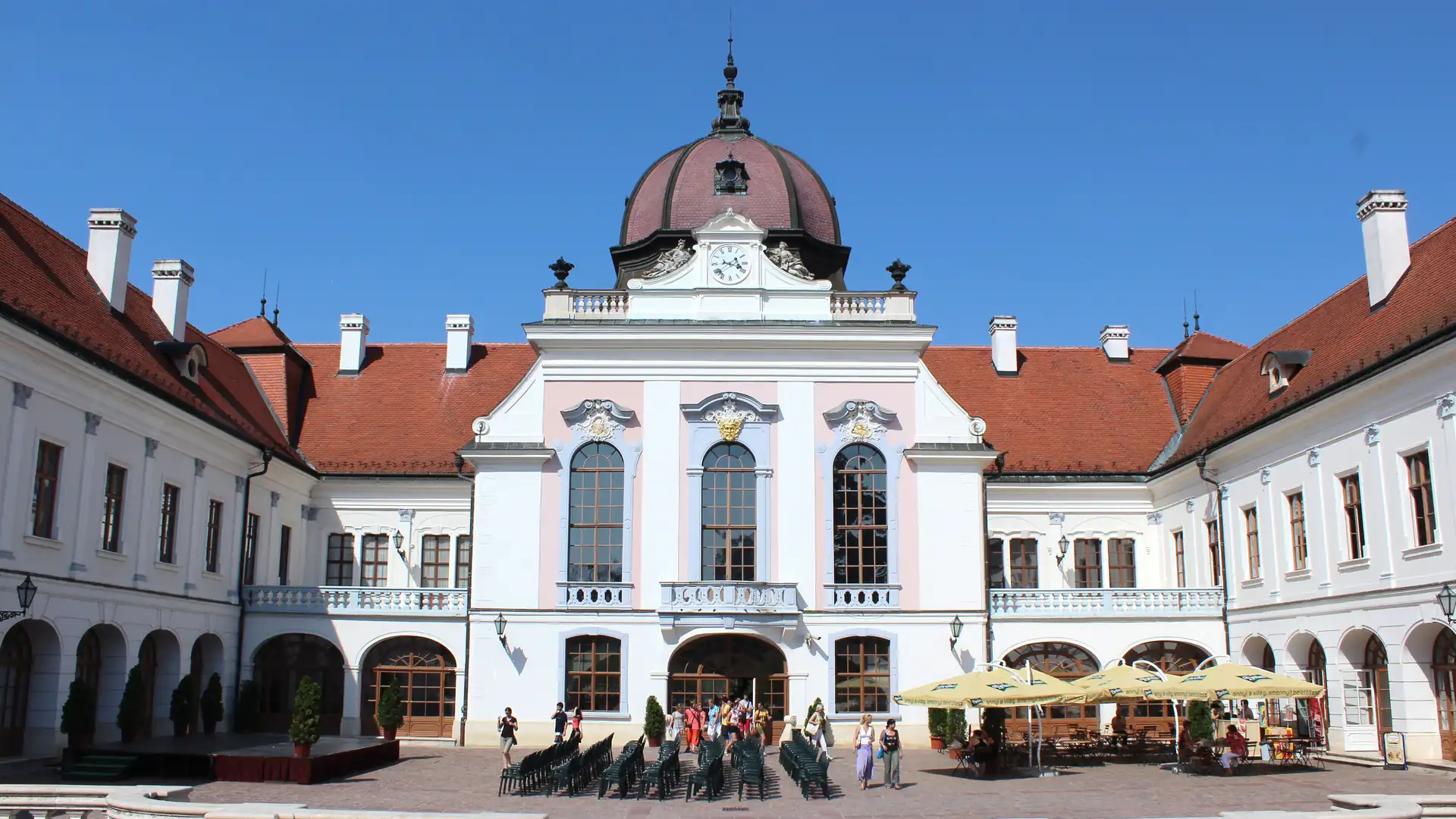
The year 1867 changed everything for Elisabeth and for Gödöllő alike. That summer the Austro-Hungarian Compromise — the Ausgleich — reorganised the Habsburg empire into the Dual Monarchy of Austria-Hungary, restoring Hungary's constitution and its own government under a shared crown. On 8 June 1867 Franz Joseph and Elisabeth were crowned King and Queen of Hungary in Buda in a ceremony of enormous emotional weight, and Andrássy, the man the empress had championed, became the first prime minister of the new Hungarian government. As a gesture of national gratitude and affection, the Hungarian nation presented the royal couple with the palace at Gödöllő, which parliament had designated as a royal residence. For Elisabeth it was the perfect gift: a country retreat in the land she loved, at a comfortable distance from Vienna, set in rolling wooded country ideal for the riding that was her passion. She embraced it at once, and the following year, in 1868, she gave birth to her youngest and most cherished daughter, Marie Valerie, who was so closely associated with the palace that Hungarians affectionately called her 'the Hungarian child'. Gödöllő was, from that moment, not merely a possession but a home.
Life at Gödöllő
For half a century, until the monarchy ended in 1918, Franz Joseph and Elisabeth spent long stretches of each year at Gödöllő, and it is Elisabeth's presence that the palace remembers most vividly. Here, away from the suffocating etiquette of Vienna, she could live closer to the pattern she wanted. She rode — famously and tirelessly — through the great park and the surrounding countryside, counted among the finest horsewomen in Europe and often accompanied by the best riders of the day. She walked for hours, took the air, read and wrote, and kept her own hours in her violet-toned apartments, which survive as one of the emotional centres of any visit. The court came with her, of course; Gödöllő could function as a seat of government when the sovereigns were in residence, and the state rooms and Grand Hall saw their share of ceremony and reception. But the palace's character was shaped by the empress's craving for privacy and open air, and the balance it struck between royal grandeur and personal retreat is precisely what makes it feel different from a purely ceremonial palace. When you stand in her rooms today, restored to their 1880s appearance, you are looking at the setting of the happiest and freest part of a famously unhappy life.
Tragedy and the Sisi legend
Elisabeth's later years were darkened by loss, above all the death of her only son, Crown Prince Rudolf, in 1889, after which the empress withdrew almost entirely into mourning, wore black for the rest of her life and travelled restlessly across Europe. On 10 September 1898, while walking to board a steamship on the shore of Lake Geneva, she was stabbed by an Italian anarchist, Luigi Lucheni, and died of her wound — an assassination that shocked the continent and sealed her passage from empress into legend. In the decades since, Sisi has become one of the most enduring figures of European popular imagination, her beauty, independence and melancholy retold in books, films and a hugely popular series of romantic movies. Hungary has kept its own, warmer version of her memory, honouring the queen who learned its language and loved its countryside. Gödöllő is where that memory is most tangible. The palace does not present a fairy tale; it presents the real rooms, the real park, the real horses' world in which a complicated woman found her rare moments of freedom. That is what gives a visit its quiet power — and why, for many travellers, standing in Sisi's Gödöllő apartments is the most affecting moment of a trip to Hungary.
Seeing Sisi's Gödöllő today
The palace you visit today has been deliberately restored to evoke the royal era, and Elisabeth's world is its centrepiece. In the permanent exhibition you walk through the ceremonial state rooms and the dazzling Grand Hall before reaching the private apartments, where the empress's rooms are furnished in the violet and lilac she favoured and hung with portraits that follow her from youthful beauty to black-clad mourning. Displays throughout set her story in context — the Bavarian childhood, the Vienna marriage, the love affair with Hungary, the coronation of 1867, the long Gödöllő summers — so that even a visitor arriving knowing only the name leaves with the whole arc of her life. To make the most of it, give yourself unhurried time in the apartments rather than sweeping through, and step out afterwards into the park she loved, where the scale of her passion for riding and open air becomes real. If you would like to go further, ask about adding a guided tour or an audio guide when you book; both deepen the picture. We are a concierge service and arrange your dated entry in advance for the day you choose, so you can concentrate on the empress and her palace rather than on an unfamiliar booking site. Carry a valid student card if you are travelling on the student ticket, as proof is checked at the entrance.
Frequently asked
Why did Sisi love Gödöllő so much?
At Gödöllő, Empress Elisabeth escaped the rigid etiquette of the Vienna court. She rode and walked in its great park, kept her own hours in her violet apartments, and lived in the Hungarian countryside she adored. It was the freest, happiest setting of her life, which is why it remains inseparable from her memory.
How did the royal family come to own Gödöllő?
After the Austro-Hungarian Compromise of 1867 and the coronation of Franz Joseph and Elisabeth as King and Queen of Hungary on 8 June 1867, the Hungarian nation presented them with the palace at Gödöllő as a coronation gift. It became their Hungarian residence until the monarchy ended in 1918.
Did Elisabeth really speak Hungarian?
Yes. Elisabeth learned to speak fluent Hungarian, an unusual and politically meaningful gesture for a Habsburg empress. She surrounded herself with Hungarian companions and supported Hungarian autonomy, which is a large part of why she is remembered so warmly in Hungary to this day.
What happened to Sisi?
Empress Elisabeth was assassinated in Geneva on 10 September 1898, stabbed by the anarchist Luigi Lucheni as she walked to board a steamship. Her death shocked Europe and helped turn her into the enduring 'Sisi' legend retold in books and films ever since.
Can I see Sisi's own rooms at Gödöllő?
Yes. Empress Elisabeth's private apartments, furnished in her favoured violet and lilac tones, are a centrepiece of the permanent exhibition, restored to their 1880s appearance. They are included in the standard museum ticket, which we arrange and email to you for your chosen date.