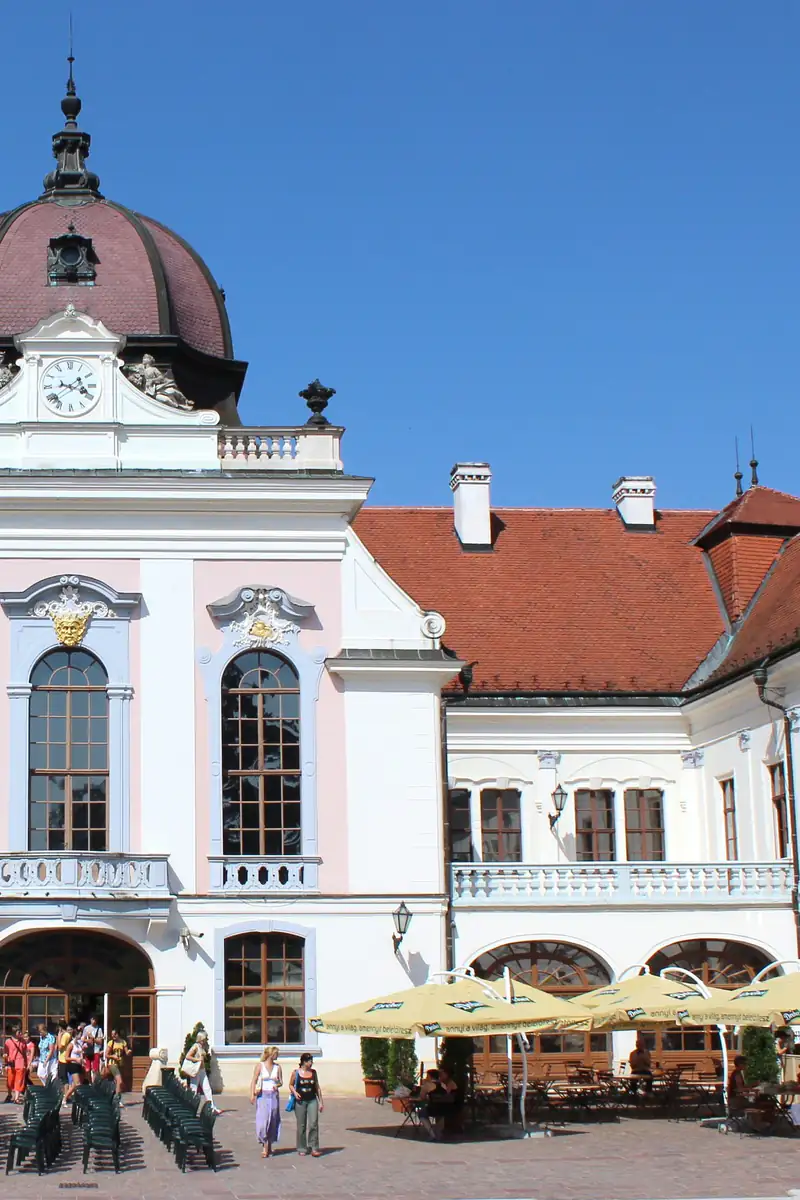
Set among gentle wooded hills a short train ride northeast of Budapest, the Royal Palace of Gödöllő is the largest Baroque palace in Hungary — and, for many Hungarians, the most beloved. Its long ochre-yellow wings open in a great double horseshoe around a ceremonial forecourt, and behind them stretch formal terraces, an English landscape park and the rose gardens that Empress Elisabeth loved. Inside, more than twenty rooms have been brought back to how they looked in the 1880s, from the gilded Grand Hall to the private apartments of the empress the whole country still calls simply Sisi.
The palace was raised for the Grassalkovich family, the greatest Hungarian aristocratic dynasty of the Baroque age. Count Antal Grassalkovich I, a confidant of Empress Maria Theresa, began the mansion around 1735 to designs by the Salzburg-trained architect András Mayerhoffer, and three generations enlarged it into a court in miniature, complete with its own church, riding hall, hothouses and one of the earliest surviving palace theatres in Europe. By the time the family line ended in 1841, Gödöllő was already a byword for aristocratic splendour on a royal scale.
In 1867, as Franz Joseph and Elisabeth were crowned King and Queen of Hungary in the great Compromise that created Austria-Hungary, the nation presented them with Gödöllő as a coronation gift. Elisabeth adored it, and returned for months every year to ride, walk and escape the stiff formality of the Vienna court until the monarchy fell in 1918. The twentieth century was harsher: Regent Miklós Horthy used the palace between the wars, Soviet and Hungarian troops occupied it after 1945, and parts became an old people's home before a long restoration from the 1980s onward returned the building to life as a museum.
We are a concierge service: you choose your visit date, we arrange and secure the entry ticket on your behalf, and it arrives in your inbox ready to show at the palace. No wrestling with an unfamiliar Hungarian booking site, no guessing at ticket categories — just your ticket, in English, in your email.